

Courses are listed first, then pages, then news.
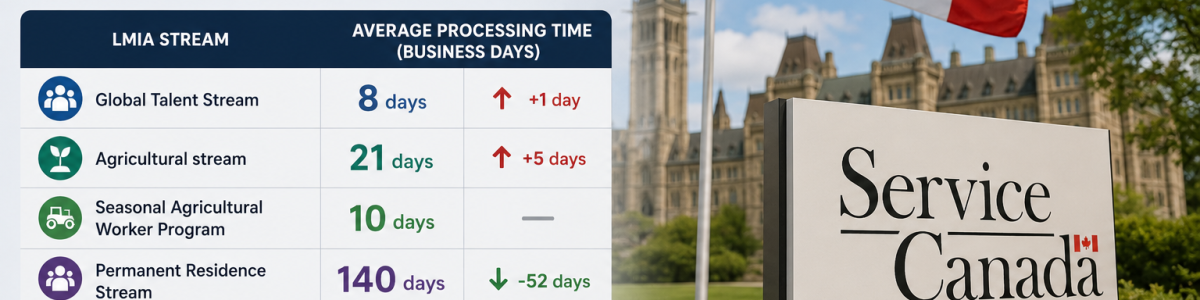
On May 15, 2026, Employment and Social Development Canada (ESDC) released updated processing time data for Labour Market Impact Assessment (LMIA) applications under the Temporary Foreign Worker Program (TFWP). Based on aggregate statistics from all Service Canada processing centres, the update shows increased processing times across most streams, with two notable exceptions.
Updated LMIA Processing Times — May 2026
| Stream | Processing Time (Business Days) | Change |
|---|---|---|
| Global Talent Stream | 8 | +1 day |
| Agricultural Stream | 21 | +5 days |
| Seasonal Agricultural Worker Program | 10 | No change |
| Permanent Residence Stream | 140 | 52 days |
| High-Wage Stream | 64 | +5 days |
| Low-Wage Stream | 58 | +8 days |
Stream-by-Stream Breakdown
The High-Wage and Low-Wage streams continue to trend upward, now sitting at 64 and 58 business days respectively. For practitioners managing employer clients in these streams, timeline planning and proactive communication with employers about lead times remain essential.
The Agricultural Stream has also increased to 21 business days, a notable shift for an area where seasonal hiring timelines are tight and delays carry real operational consequences.
The Global Talent Stream remains well within ESDC’s 10-business-day service standard at 8 business days, despite a one-day increase. Employers hiring under this stream continue to benefit from significantly faster processing compared to other TFWP streams.
The Seasonal Agricultural Worker Program holds steady at 10 business days, reflecting continued processing priority for this time-sensitive program.
The most significant development in this update is in the Permanent Residence Stream, which has decreased by 52 business days to 140 business days. While 140 business days remains a lengthy timeline, this reduction will be welcome news for employers and workers pursuing this pathway.
Practitioner Implications
Month-to-month fluctuations in LMIA processing times are driven by application volume, compliance review requirements, and operational factors at Service Canada processing centres. Practitioners should treat published figures as planning indicators rather than fixed timelines, and build buffer periods into employer hiring schedules accordingly.
For positions where timing is critical, particularly in the agricultural and high-wage categories, it is worth assessing whether LMIA-exempt pathways under the International Mobility Program may offer a more predictable route.
Incomplete applications continue to be a primary cause of delays across all streams. Processing begins only once ESDC receives a complete submission through LMIA Online, with all required documents, employer signatures, and applicable fees included.
For the most current processing time data, practitioners can consult the official ESDC page directly: Labour Market Impact Assessment application processing times — Canada.ca
Join Us: Navigating LMIAs From Application to Approval
If you advise employers or foreign nationals on LMIA-dependent work permits, LPEN’s upcoming course Navigating LMIAs: From Application to Approval 2026 on July 23, 2026 is a comprehensive, 6-hour session covering every stage of the LMIA process, from preparing a strong application to managing compliance obligations post-approval. Instructors Andrew Carvajal and Viviane Albuquerque bring extensive hands-on expertise to this essential topic. Learn more and register here.
#esdc #service_canada #lmia #tfwp #work_permit #agricultural_workers #caregivers
Don’t miss the chance to join one of our upcoming courses!
Join 10,000+ Professionals and get courses updates, news and free premium content and videos.