
Courses are listed first, then pages, then news.
Immigration, Refugees and Citizenship Canada (IRCC) has updated its guidance on the restoration of temporary resident status, providing important clarifications that affect how practitioners advise clients who have fallen out of status in Canada.
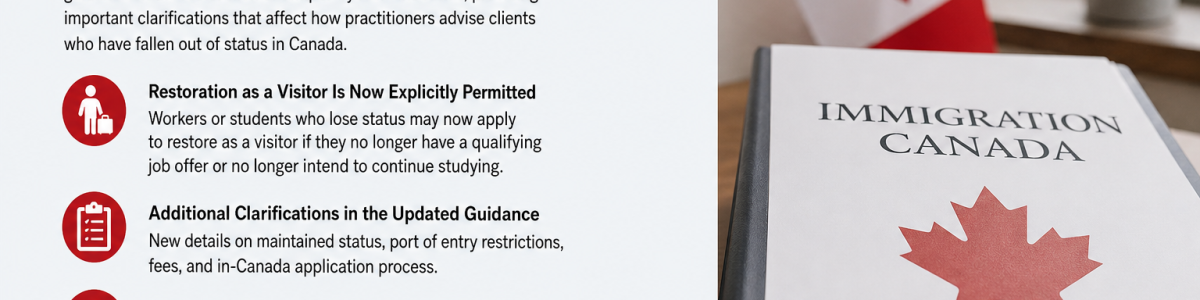
What Changed: Restoration as a Visitor Is Now Explicitly Permitted
The most significant shift in the updated guidance addresses a longstanding ambiguity around the class to which an applicant can restore. The previous version stated that an applicant could only restore their status and authorization to the one they held immediately before applying — language that implied a worker had to restore as a worker, or a student as a student. That wording did not accurately reflect what was permitted in practice.
The updated guidance now makes clear that a worker or student who loses temporary resident status may apply to restore as a visitor, provided they no longer have a qualifying job offer or no longer intend to continue studying. This removes the blanket same-class requirement from the public-facing instructions and codifies the flexibility that officers were already applying.
Additional Clarifications in the Updated Guidance
Beyond the visitor restoration clarification, IRCC introduced several other updates practitioners should note:
The guidance provides more detail on how maintained status interacts with restoration. Where an application is rejected as incomplete (as opposed to refused), the applicant does not benefit from maintained status, and the 90-day restoration period runs from the end of the original authorized stay, not from the date of the incomplete rejection.
The updated guidance also explicitly states that restoration cannot be applied for or granted at a port of entry. Previously, the instructions only said it could not be granted at a port of entry. The revised wording closes a potential ambiguity: restoration is an in-Canada application process, full stop.
The guidance also clarifies that the restoration fee must be paid within the 90-day window, not submitted as a correction after the fact. Where a work or study permit is being requested alongside restoration, the applicable permit fee is also required at the time of application.
Finally, internal processing detail previously included in the guidance has been removed. The revised guidance focuses on applicant-facing eligibility criteria.
Unchanged: Core Framework Under IRPR s. 182
The fundamental structure of restoration remains unchanged. Applicants must be in Canada, out of status, within 90 days of losing temporary resident status, and must meet the requirements for the class to which they are restoring. Working or studying without authorization during the out-of-status period continues to make an applicant ineligible. Temporary Resident Permit holders remain ineligible for restoration under section 182 of the IRPR and must apply for a new TRP instead.
For the official IRCC guidance on restoration of status, visit Canada.ca.
Join us for Restoration of Status Applications 2026 on December 3, 2026, a 3-hour course with instructor Adrienne Smith offering a practical guide to preparing and submitting restoration applications under Canadian immigration law. Register at lpen.ca.
#canada_immigration, #ircc, #temporary_resident_status, #restoration_of_status, #canadian_visa, #irpr, #visitor_status, #study_permits, #work_permits
Don’t miss the chance to join one of our upcoming courses!
Join 10,000+ Professionals and get courses updates, news and free premium content and videos.